
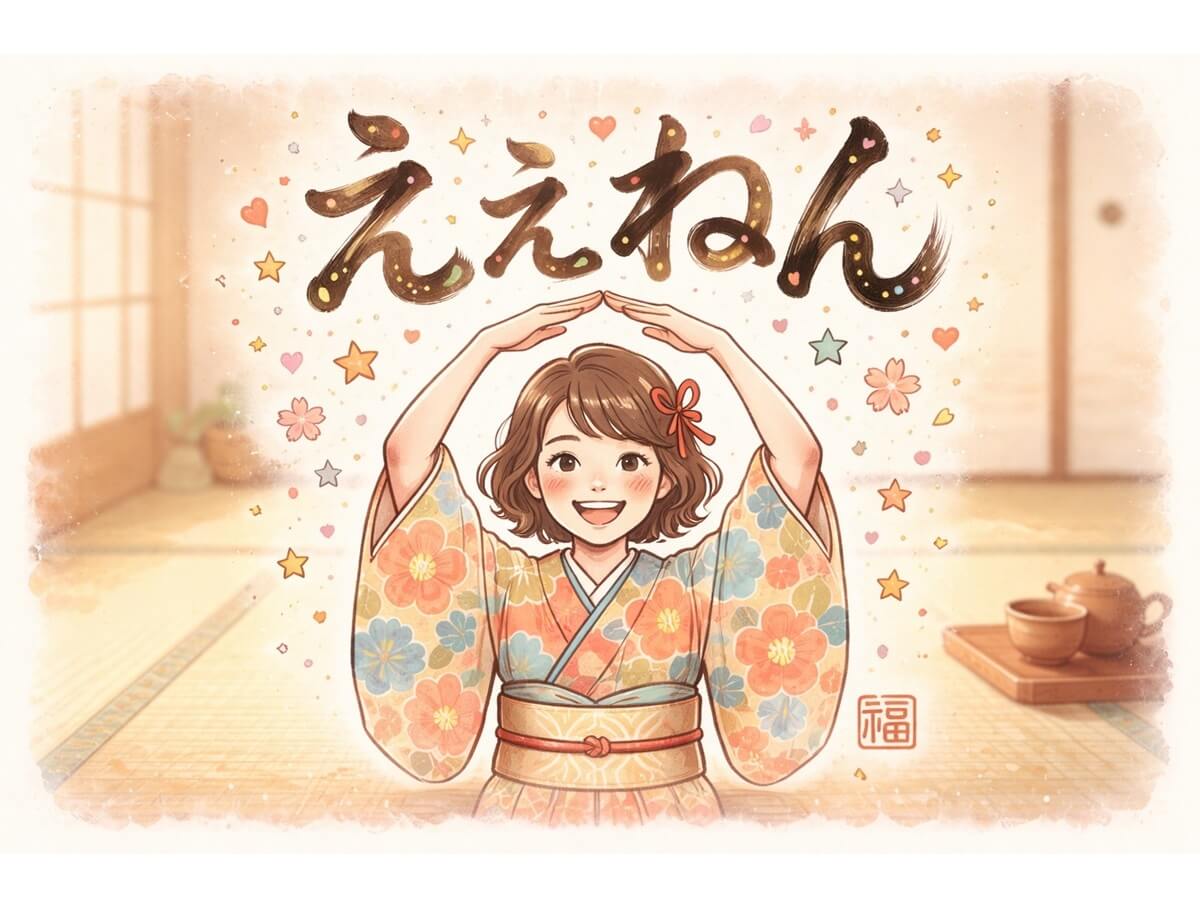
“Ee” — More Than Just “Good”
A previous article on this website introduced the interesting idea that the single Japanese “Eh” (え) can express many different meanings depending on the situation. This time, I would like to take a look at what happens when that becomes “ee” (ええ/Ehh), one of the most common and expressive words in Osaka dialect.
Note: Japanese learners may already be familiar with the romanized spelling “ee.” In this article, I use that spelling throughout. Although written with two e’s, it is normally pronounced as a single long vowel sound, “ehh” (like a prolonged “eh”), rather than two separate “eh” sounds. In the International Phonetic Alphabet (IPA), this sound is represented as /eː/.
The word “ee” (ええ) is a familiar everyday expression in Osaka dialect and throughout the wider Kansai region. It corresponds to the standard Japanese word “ii” (いい), meaning “good.”
For example:
- “Kyō wa ee tenki ya na.”
(It’s nice weather today.) - “Ee mise mitsuketa yo.”
(I found a good shop.)
“Mō Ee Wa!” — A Famous Manzai Phrase
Although its basic meaning is “good” or “nice,” “ee” often sounds warmer and friendlier than its standard Japanese equivalent. It can carry a sense of affection toward what is being described.

The phrase “Mō ee wa!” is another common expression. It means something like “That’s enough.” You may have heard it if you are a fan of Japanese manzai comedy. In comedy, it is often delivered with good humor, signaling that the joke has reached its punchline rather than expressing genuine frustration.
In this way, the word “ee” can take on different shades of meaning depending on the situation and the relationship between the speakers.
This video features a collection of scenes from Kansai manzai performances where comedians say the famous phrase “Mō ee wa.”
The Message Behind “Eenen” by the Ulfuls
Now, what happens when we add the Osaka dialect ending “nen” (ねん) to “Ee”?
The result is “eenen” (ええねん), pronounced roughly as “ehh nen” (/eː nen/ in IPA).
“Eenen” roughly means “ii n da yo” (“It’s okay” or “It’s fine”). However, that translation does not fully capture its feeling. “Eenen” carries a warm sense of acceptance and understanding.
- “Kanpeki ja nakutemo eenen.”
(You don’t have to be perfect.) - “Shippai shitemo eenen.”
(It’s okay to make mistakes.) - “Sonomama de eenen.”
(You are fine just as you are.)
It is a phrase that gently reminds people that they are okay just as they are.
One song that beautifully captures this message is “Eenen” by the Ulfuls, one of Osaka’s most beloved bands.
The Japanese lyrics can be found here:
https://www.uta-net.com/song/18112/
Throughout the song, the lyrics explore themes of self-acceptance and finding meaning in everyday life. They remind us that it is okay to fail, to cry, to rest, and even to feel lost at times. One line in the song suggests that simply sharing a dream with someone can be enough.
A Final Thought on “Eenen”
Rereading these lyrics recently, I found myself thinking about something.
Sometimes, we may lose someone special, our feelings drift apart, or the dream itself never comes true. Even so, the time we spent together or the efforts we made do not disappear from our lives. What those experiences left behind remains with us, even as life carries us forward.
The more precious those memories are, the harder it can be to take a new step. You might sometimes feel guilty about moving forward.
But perhaps we do not have to choose between the past and the future.
We can carry those memories with us and still make room for something new.
Maybe that is “Eenen,” too.
When you feel a little tired, remember this word: “Eenen.” You are fine just as you are.

I live in Osaka and volunteer as a Japanese teacher. After I retire, I’d love to live in Malta in the Mediterranean or on Yakushima Island in Japan someday.
 HTJ has a YouTube page! Check it out